SERVICES
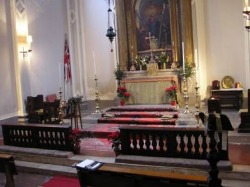
St. George’s Venice is a a Chaplaincy within the Church of England Diocese in Europe. It seeks to serve Anglicans and Episcopalians from throughout the Anglican Communion and Christians of all denominations who wish to worship and participate in the life of the Church in this place. Services are conducted in English, according to authorised Anglican Liturgy.
The heart of our worshipping week is the SUNDAY HOLY EUCHARIST AT 10.30AM. This is based on the Church of England Book of Common Prayer and the Book of common Worship, with sermon, Hymns, occasional anthems and Organ voluntaries.
We hope you may have time to stay for a few minutes so that we can meet and welcome you, as it is normal for the majority of our congregation to be Visitors, and sometimes lasting friendships can start at this time.
We also offer the Eucharist on some Principal Saints’ Days and Festivals, and of course at Christmas and Easter.
A short reflection on the service, by the Chaplain, Fr. Howard Levett
Because on the last night of his earthly life, Jesus instructed his disciples to ‘Do this in anamnesis of me’ (a way of ‘remembrance’ that brings the past into the present and takes the present back to the past and additionally points toward the future), Christians have sought the presence of their Lord in doing what he told them to do – bringing bread and wine to Him for Him to TAKE, for Him to MAKE it blessed, for Him then to BREAK the bread and finally GIVE it back to his people as His holy body and blood.
This distinctive act of Christian worship has variously been called ‘Holy Communion’, ‘The Lord’s Supper’, ‘The Liturgy’, ‘The Eucharist’ and ‘The Mass’.
Each of these names points to one element of the service. In fact there is no name that can adequately express the full meaning of the mystery celebrated in this service - namely the wonderful mystery by which the sacrifice of Christ upon the Cross brought about the reconciliation of the broken relationship between God and humanity and between each one of us with Our Lord.
Both the joyful and the tragic elements in the God-Man story are celebrated in this act of worship and those who worship ‘in spirit and in truth’ will each bring to the service both the joyful and sorrowful elements that are a part of every human life. Each must prepare heart, mind and body to receive the presence of the Lord – admission and confession of sins is an essential part of this – otherwise we will not be able to sense and discern the real presence of The Lord at this service. Precisely how we understand the ‘mechanisms’ by which His ‘real presence’ among us takes place is less important than that we believe that when he said he would be present whenever ‘you do this in remembrance of me’ he actually meant it.
The Church of England invites to Communion all baptized persons who are communicant members of other Churches that subscribe to the doctrine of the Holy Trinity, and who are in good standing in their own Church. Those who are prevented by conscience or the rules of their own Church from receiving the Blessed Sacrament are invited to the altar to receive a blessing.
FOUR FAQ's
asked about our Sunday service by visitors unfamiliar with traditional Anglican worship
The Why's and Wherfore's of the Service structure and language.
(Q) Why do Anglican services have to be structured at all?
(A) Apart from the chaos that would ensue if they weren't (given the mighty breadth of 'Anglican opinions'!) the GIVENS in Christian worship were set long ago by our Jewish ancestors in Temple, Synagogue and home. These were the forms of worship Our Lord Jesus Christ as well as his apostles knew and practiced. The services of Morning and Evening Prayer (Matins and Evensong) are derived, by way of monastic services, from Synagogue worship. The Eucharist of course all Christians were commanded to celebrate by Jesus himself at the Last Supper. Hence its central place in Christian worship.
(Q) Couldn't the Eucharist be celebrated less formally?
(A) Yes and it often is BUT its formal nature reminds us that it is not just a jolly luch party for like-minded groups of people. It is nothing less than a re-presenting to the whole world the meaning of Christ's death on the cross and resurrection from it. It also encompasses a very great deal more for not only is Jesus and his sacrifice deeply and thankfully remembered but what is also celebrated are God's actions in Creation and history and his dramatic intervention in causing his Son to be born to save a world that had gone badly wrong.
The Eucharist is also the gateway to the future, the future of all life that will survive the end of creation as we now know it as well as the future of each person who eats and drinks in the heavenly kingdom now as we 'get a taste' of what our individual soul's future holds for us.
In the Eucharist we encounter the Son of God by the power of the Holy Spirit and are caught up into the eternal offering of love that Jesus gives to his Father in the presence of the whole company of heaven. At the same time during the Eucharist a glimpse of heaven and its worship is brought down to earth.
The formal nature of the service is meant to lead us to contemplate these tremendous things that are beyond simplistic human understanding. Therefore a true act of worship will not be about pandering to entertainment value nor to personal or community/social navel gazing but an action in which human persons are caught up into the transcendance of God.
(Q) Why does the service have to be in 16th/ 17th Century English?
(A) It doesn't have to be and there are many alternative services to those in the BCP of 1662 used today throughout the Anglican world. In fact 'Liturgy' (Services) throughout the Christian centuries has taken differing shapes, as is easily seen for example in the differences between the Eucharist in the Orthodox and Catholic worlds.
The 1662 BCP is also a service book that was developed from the earliest known rites of the early Christian church, via the Orthodox and Roman Catholic churches and had precursors in the English Prayer books of 1549 and 1552 where the same 'Prayer book language' is to be found. The 1662 book was however a major marker in the development of a book that it was imagined could and would be used by all the English nation and although it did not of course achieve that particular objective, it was used in all English cathedrals and parish churches, virtually unchanged for over 250 years. Its familiar words and the beautiful Cranmerian English in which they were framed determined a common identification of Anglicans and anglicanism transcending various shades of 'churchmanship ' - low, middle or high. By 1928 however to many in the Church of England it seemed the time had come to do something about preventing the 1662 from turning into a fossil.
Already in the rest of the Anglican world a number of changes to the 1662 book had become an absolute necessity for by that time hundreds of thousands of Anglicans were not Englishmen, nor owning political allegiance to the English crown, nor ecclesiastical allegiance to the Established Church.
There were other factors too. Liturgical scholarship had shown that certain things that had shaped and then re-shaped the Prayer Books of 1549, 1551 and 1662 had been either mistakes or importations from less than reliable and/or out-dated sources, both liturgical, theological and even political. Thus in 1927 and 1928 a conservative revision to the 1662 was proposed. The 1928 book made few changes to the language of the services but although these were agreed by the Church through its bishops, the British Parliament turned them down. The church started to use the 1928 book anyhow. It would be another forty years before the changes finally became legal and by that time the desire for revision had become so strong that soon an Alternative Service Book came into being , incorporating not only many of the 1928 changes but also producing new services that departed in both shape and language from the 1662 book. Liturgical change was also taking place in the Roman Catholic and Protestant churches. The most recent change in the C of E has been the arrival of the Book of Common Worship that replaces the ASB and has incorporated much material from the Book of Common Prayer.
Yet many Anglicans (and many non-worshipping lovers of the English language) remained deeply attached to the 350 year old 1662 BCP and most particularly to its language and that attachment is also felt by Anglicans from all over the Anglican /Episcopal world.
Today amidst the Anglican Communion's uncertainties and confusions perhaps the common denominator that can provide at least one anchor of common identity and stability is the use of the BCP – not COLD of course but acknowledging the need for some accommodation with genuinely grounded and scholarly liturgical insights as well as with the up-dating required by our contemporary living in a global 21st Century village rather than English village of the 16th Century. Given the many visitors from the Anglican world of many different stripes who attend our church in Venice throughout the year we consider it the right option for us to continue with a basically BCP service. We are also conscious of the fact that in a city of God-given and human instrumental beauty it would be a mistake if we too did not make use of the God-given beauty available to us through the magnificent language of the Prayer Book.
(Q) Why does the priest wear special clothes for the service and why do the colours of his clothes and the cloths that cover the vessels used in the service sometimes change?
(A) Each piece of clothing the priest wears has a meaning. Taken all together they are a reminder to him and to the congregation that it is not the personal character or any particular skill of the priest that is of overriding importance in the service.
Each garment represents something about Christ. Actually the most important garment is the one almost unseen when the priest is in full vesture. This is the STOLE or scarf that is worn on top of the long white garment called an ALB. It is virtually hidden when the priest wears the 'blanket-like' garment called a CHASUBLE. The STOLE started life out as the distinguishing garment of a prophet in the Old Testament – there called a 'Mantle' (or scarf). (e.g.Elijah and Elisha) Jesus was the 'seal' (final) prophet of God and priests are called to proclaim the prophetic words and actions of Jesus.
The ALB is a reminder from the Book of Revelation in the New Testament that those whose lives have been washed white and clean of sin by the Blood of the Lamb (Jesus) are in heaven identified by wear ing white clothes. Thus this garment is a reminder to priest and people that we are called to live lives that have been made clean by the life, death and resurrection of Our Lord. The Alb is held in place by a GIRDLE and is a reminder that in the words of St. Paul Christians are to gird themselves with truth, and having on the breastplate of righteousness; Eph 6:14 (KJV)
The top of the alb may have a hood or an extra piece of cloth attached to it , otherwise there will be a separate item called an AMICE. The Amice (hood, or attached extra material) represents the 'helmet of salvation' – the idea once again based on St. Paul's words in Ephesians.
The CHASUBLE, is the most prominent item in the priest's apparel and represents the 'yoke' that Christians are called upon to bear – the wounds and hurts of the world and the separation from God ( Sin) that they are a part of and that Jesus was born, lived , died and rose from the dead for, in order to heal. Priest and people are called to be the bearers of the cross in the world of today. A terribly important part of the priest's preparation before leading the people of God in worship are the special prayers that he must recite as he dons each article of the special clothes. (Vestments)
The COLOURS change in order to make us all aware of the various seasons of the Christian year and the meaning of that season or day's message for us. PURPLE is the colour used during the Advent and Lent seasons. It is not meant to be a grim colour but it is the colour deliberately chosen to contrast with the colour used at Christmas and Easter, the two great festivals that follow Advent and Lent. So Purple is the 'John the Baptist' colour reminding us that we will be completely unable to receive the Grace of The Lord's presence unless we too have made every effort to make God's pathway to the human soul as straight and true as possible. WHITE or GOLD are the joyful colours used to denote The Lord's victory over sin and death. BLACK, the colour of mourning is used exclusively for Funeral services and Requiems. GREEN, 'Nature's' chief colour is the colour for 'Ordinary' Sundays of the year, a reminder that the whole of life is God's gift.
The Venerable Howard Levett. Chaplain St. George's Venice & Christ Church Trieste. June 2011 revised January 2013 (c)
_______________________________________________________________________________________________
The short commentary and Q&A's by the Chaplain are produced principally for the benefit of members of other denominations who attend St. George's whilst visiting Venice.
The heart of our worshipping week is the SUNDAY HOLY EUCHARIST AT 10.30AM. This is based on the Church of England Book of Common Prayer and the Book of common Worship, with sermon, Hymns, occasional anthems and Organ voluntaries.
We hope you may have time to stay for a few minutes so that we can meet and welcome you, as it is normal for the majority of our congregation to be Visitors, and sometimes lasting friendships can start at this time.
We also offer the Eucharist on some Principal Saints’ Days and Festivals, and of course at Christmas and Easter.
A short reflection on the service, by the Chaplain, Fr. Howard Levett
Because on the last night of his earthly life, Jesus instructed his disciples to ‘Do this in anamnesis of me’ (a way of ‘remembrance’ that brings the past into the present and takes the present back to the past and additionally points toward the future), Christians have sought the presence of their Lord in doing what he told them to do – bringing bread and wine to Him for Him to TAKE, for Him to MAKE it blessed, for Him then to BREAK the bread and finally GIVE it back to his people as His holy body and blood.
This distinctive act of Christian worship has variously been called ‘Holy Communion’, ‘The Lord’s Supper’, ‘The Liturgy’, ‘The Eucharist’ and ‘The Mass’.
Each of these names points to one element of the service. In fact there is no name that can adequately express the full meaning of the mystery celebrated in this service - namely the wonderful mystery by which the sacrifice of Christ upon the Cross brought about the reconciliation of the broken relationship between God and humanity and between each one of us with Our Lord.
Both the joyful and the tragic elements in the God-Man story are celebrated in this act of worship and those who worship ‘in spirit and in truth’ will each bring to the service both the joyful and sorrowful elements that are a part of every human life. Each must prepare heart, mind and body to receive the presence of the Lord – admission and confession of sins is an essential part of this – otherwise we will not be able to sense and discern the real presence of The Lord at this service. Precisely how we understand the ‘mechanisms’ by which His ‘real presence’ among us takes place is less important than that we believe that when he said he would be present whenever ‘you do this in remembrance of me’ he actually meant it.
The Church of England invites to Communion all baptized persons who are communicant members of other Churches that subscribe to the doctrine of the Holy Trinity, and who are in good standing in their own Church. Those who are prevented by conscience or the rules of their own Church from receiving the Blessed Sacrament are invited to the altar to receive a blessing.
FOUR FAQ's
asked about our Sunday service by visitors unfamiliar with traditional Anglican worship
The Why's and Wherfore's of the Service structure and language.
(Q) Why do Anglican services have to be structured at all?
(A) Apart from the chaos that would ensue if they weren't (given the mighty breadth of 'Anglican opinions'!) the GIVENS in Christian worship were set long ago by our Jewish ancestors in Temple, Synagogue and home. These were the forms of worship Our Lord Jesus Christ as well as his apostles knew and practiced. The services of Morning and Evening Prayer (Matins and Evensong) are derived, by way of monastic services, from Synagogue worship. The Eucharist of course all Christians were commanded to celebrate by Jesus himself at the Last Supper. Hence its central place in Christian worship.
(Q) Couldn't the Eucharist be celebrated less formally?
(A) Yes and it often is BUT its formal nature reminds us that it is not just a jolly luch party for like-minded groups of people. It is nothing less than a re-presenting to the whole world the meaning of Christ's death on the cross and resurrection from it. It also encompasses a very great deal more for not only is Jesus and his sacrifice deeply and thankfully remembered but what is also celebrated are God's actions in Creation and history and his dramatic intervention in causing his Son to be born to save a world that had gone badly wrong.
The Eucharist is also the gateway to the future, the future of all life that will survive the end of creation as we now know it as well as the future of each person who eats and drinks in the heavenly kingdom now as we 'get a taste' of what our individual soul's future holds for us.
In the Eucharist we encounter the Son of God by the power of the Holy Spirit and are caught up into the eternal offering of love that Jesus gives to his Father in the presence of the whole company of heaven. At the same time during the Eucharist a glimpse of heaven and its worship is brought down to earth.
The formal nature of the service is meant to lead us to contemplate these tremendous things that are beyond simplistic human understanding. Therefore a true act of worship will not be about pandering to entertainment value nor to personal or community/social navel gazing but an action in which human persons are caught up into the transcendance of God.
(Q) Why does the service have to be in 16th/ 17th Century English?
(A) It doesn't have to be and there are many alternative services to those in the BCP of 1662 used today throughout the Anglican world. In fact 'Liturgy' (Services) throughout the Christian centuries has taken differing shapes, as is easily seen for example in the differences between the Eucharist in the Orthodox and Catholic worlds.
The 1662 BCP is also a service book that was developed from the earliest known rites of the early Christian church, via the Orthodox and Roman Catholic churches and had precursors in the English Prayer books of 1549 and 1552 where the same 'Prayer book language' is to be found. The 1662 book was however a major marker in the development of a book that it was imagined could and would be used by all the English nation and although it did not of course achieve that particular objective, it was used in all English cathedrals and parish churches, virtually unchanged for over 250 years. Its familiar words and the beautiful Cranmerian English in which they were framed determined a common identification of Anglicans and anglicanism transcending various shades of 'churchmanship ' - low, middle or high. By 1928 however to many in the Church of England it seemed the time had come to do something about preventing the 1662 from turning into a fossil.
Already in the rest of the Anglican world a number of changes to the 1662 book had become an absolute necessity for by that time hundreds of thousands of Anglicans were not Englishmen, nor owning political allegiance to the English crown, nor ecclesiastical allegiance to the Established Church.
There were other factors too. Liturgical scholarship had shown that certain things that had shaped and then re-shaped the Prayer Books of 1549, 1551 and 1662 had been either mistakes or importations from less than reliable and/or out-dated sources, both liturgical, theological and even political. Thus in 1927 and 1928 a conservative revision to the 1662 was proposed. The 1928 book made few changes to the language of the services but although these were agreed by the Church through its bishops, the British Parliament turned them down. The church started to use the 1928 book anyhow. It would be another forty years before the changes finally became legal and by that time the desire for revision had become so strong that soon an Alternative Service Book came into being , incorporating not only many of the 1928 changes but also producing new services that departed in both shape and language from the 1662 book. Liturgical change was also taking place in the Roman Catholic and Protestant churches. The most recent change in the C of E has been the arrival of the Book of Common Worship that replaces the ASB and has incorporated much material from the Book of Common Prayer.
Yet many Anglicans (and many non-worshipping lovers of the English language) remained deeply attached to the 350 year old 1662 BCP and most particularly to its language and that attachment is also felt by Anglicans from all over the Anglican /Episcopal world.
Today amidst the Anglican Communion's uncertainties and confusions perhaps the common denominator that can provide at least one anchor of common identity and stability is the use of the BCP – not COLD of course but acknowledging the need for some accommodation with genuinely grounded and scholarly liturgical insights as well as with the up-dating required by our contemporary living in a global 21st Century village rather than English village of the 16th Century. Given the many visitors from the Anglican world of many different stripes who attend our church in Venice throughout the year we consider it the right option for us to continue with a basically BCP service. We are also conscious of the fact that in a city of God-given and human instrumental beauty it would be a mistake if we too did not make use of the God-given beauty available to us through the magnificent language of the Prayer Book.
(Q) Why does the priest wear special clothes for the service and why do the colours of his clothes and the cloths that cover the vessels used in the service sometimes change?
(A) Each piece of clothing the priest wears has a meaning. Taken all together they are a reminder to him and to the congregation that it is not the personal character or any particular skill of the priest that is of overriding importance in the service.
Each garment represents something about Christ. Actually the most important garment is the one almost unseen when the priest is in full vesture. This is the STOLE or scarf that is worn on top of the long white garment called an ALB. It is virtually hidden when the priest wears the 'blanket-like' garment called a CHASUBLE. The STOLE started life out as the distinguishing garment of a prophet in the Old Testament – there called a 'Mantle' (or scarf). (e.g.Elijah and Elisha) Jesus was the 'seal' (final) prophet of God and priests are called to proclaim the prophetic words and actions of Jesus.
The ALB is a reminder from the Book of Revelation in the New Testament that those whose lives have been washed white and clean of sin by the Blood of the Lamb (Jesus) are in heaven identified by wear ing white clothes. Thus this garment is a reminder to priest and people that we are called to live lives that have been made clean by the life, death and resurrection of Our Lord. The Alb is held in place by a GIRDLE and is a reminder that in the words of St. Paul Christians are to gird themselves with truth, and having on the breastplate of righteousness; Eph 6:14 (KJV)
The top of the alb may have a hood or an extra piece of cloth attached to it , otherwise there will be a separate item called an AMICE. The Amice (hood, or attached extra material) represents the 'helmet of salvation' – the idea once again based on St. Paul's words in Ephesians.
The CHASUBLE, is the most prominent item in the priest's apparel and represents the 'yoke' that Christians are called upon to bear – the wounds and hurts of the world and the separation from God ( Sin) that they are a part of and that Jesus was born, lived , died and rose from the dead for, in order to heal. Priest and people are called to be the bearers of the cross in the world of today. A terribly important part of the priest's preparation before leading the people of God in worship are the special prayers that he must recite as he dons each article of the special clothes. (Vestments)
The COLOURS change in order to make us all aware of the various seasons of the Christian year and the meaning of that season or day's message for us. PURPLE is the colour used during the Advent and Lent seasons. It is not meant to be a grim colour but it is the colour deliberately chosen to contrast with the colour used at Christmas and Easter, the two great festivals that follow Advent and Lent. So Purple is the 'John the Baptist' colour reminding us that we will be completely unable to receive the Grace of The Lord's presence unless we too have made every effort to make God's pathway to the human soul as straight and true as possible. WHITE or GOLD are the joyful colours used to denote The Lord's victory over sin and death. BLACK, the colour of mourning is used exclusively for Funeral services and Requiems. GREEN, 'Nature's' chief colour is the colour for 'Ordinary' Sundays of the year, a reminder that the whole of life is God's gift.
The Venerable Howard Levett. Chaplain St. George's Venice & Christ Church Trieste. June 2011 revised January 2013 (c)
_______________________________________________________________________________________________
The short commentary and Q&A's by the Chaplain are produced principally for the benefit of members of other denominations who attend St. George's whilst visiting Venice.